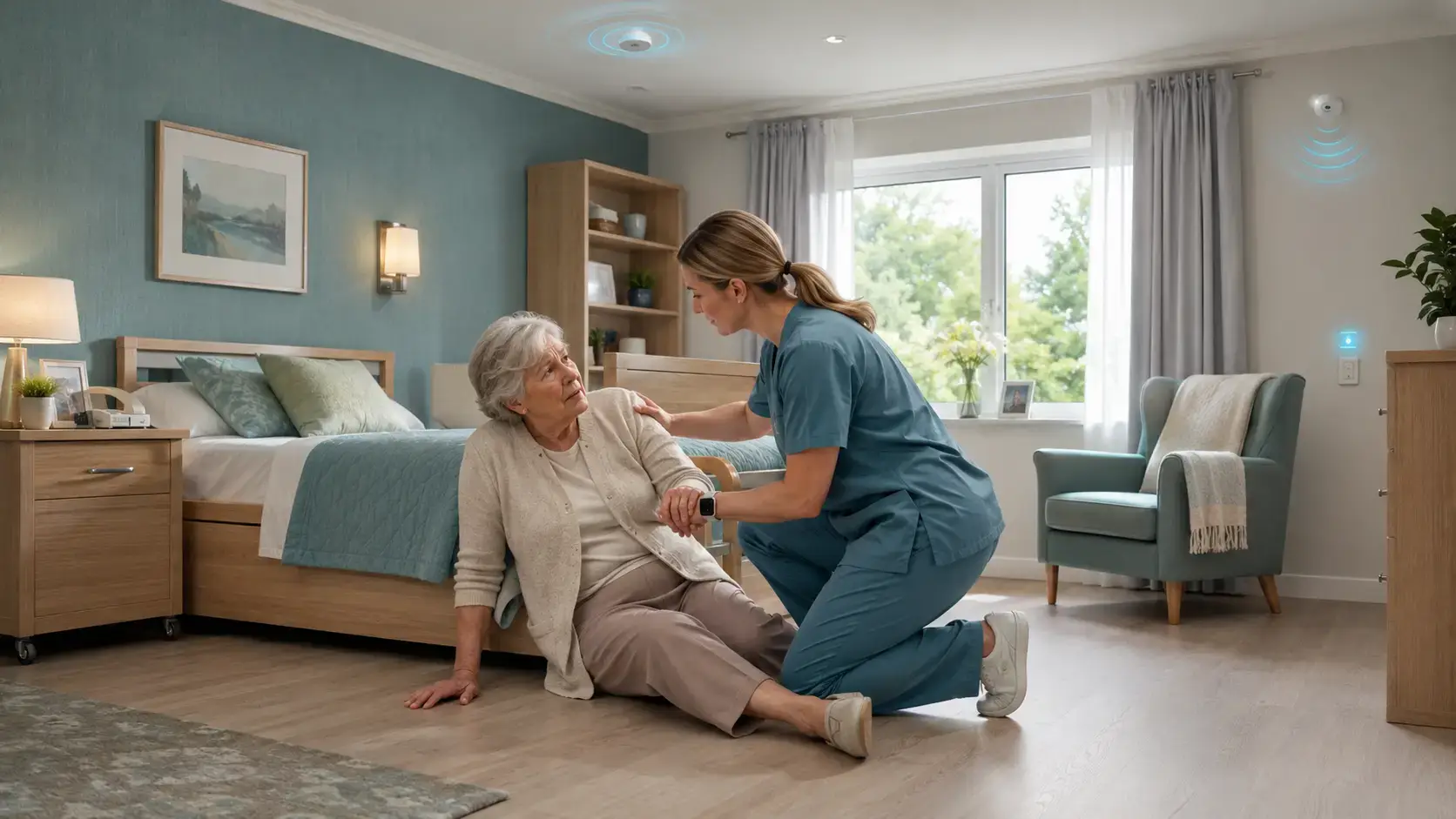


Ensuring safety in care environments is a growing challenge, especially with limited resources and increasing demands. The key question is simple: how can we improve protection without adding pressure on already stretched teams?
👉 Get my free checklist
Protect my loved one in under 5 minutes
What does improving safety without increasing workload mean?
Improving safety without increasing workload means using smarter systems and better organization to enhance protection without requiring more effort from staff.
In other words, it’s about doing better, not doing more — through early detection, automation, and optimized processes.
Key takeways
- Safety can be improved through risk prevention, not just intervention
- Automation reduces repetitive tasks and mental load
- Early detection helps avoid emergencies and urgent situations
- Smart safety technologies support staff without replacing them
- Better organization improves both safety and efficiency
Why this challenge is critical
Care environments are under pressure.
Staff often face:
- high workloads,
- time constraints,
- increasing number of residents.
This can lead to:
- delayed interventions,
- missed warning signs,
- increased risk of incidents.
Improving home safety and safety in care environments must not come at the cost of staff well-being.
Why vulnerable individuals are more exposed
Seniors and vulnerable individuals are more at risk because:
- they may have reduced mobility,
- they are more likely to experience falls,
- they may not always be able to call for help.
Without proper systems in place, small incidents can quickly become serious.
Smart ways to improve safety without adding workload
1. Focus on prevention, not reaction
- identify risks early,
- reduce hazards in the environment,
- anticipate common situations.
👉 Prevention is the most effective way to reduce workload.
2. Use early detection technologies
Modern safety technologies can:
- detect abnormal situations automatically,
- alert staff in real time,
- prioritize interventions.
This avoids constant monitoring and reduces stress.
3. Automate repetitive tasks
Automation helps:
- reduce manual checks,
- limit unnecessary rounds,
- free up time for human care.
4. Improve communication
Better communication tools allow:
- faster response,
- clearer coordination,
- reduced uncertainty.
Prevention and future perspectives
The future of care lies in intelligent prevention.
Solutions like NestSentinel illustrate this shift by:
- detecting falls, distress signals, and risks automatically,
- sending alerts in seconds,
- reducing false alarms and unnecessary interventions.
By combining AI, sensors, and real-time analysis, it becomes possible to improve safety while simplifying daily work.
Follow NestSentinel
Solutions designed to improve safety and prevent risks for seniors and vulnerable individuals are evolving rapidly thanks to technological innovation.
But even before using AI-powered solutions, there’s already a lot you can do to make your home safer.
👉 To help you take a first step, download our free checklist of the 25 hidden hazards and identify risks in just a few minutes.

Sources and references
- World Health Organization (WHO)
- OECD – Health workforce
- European Commission – Long-term care
FAQ: about resident safety
Can safety really improve without more staff?
Yes, with better organization and smart technologies, safety can increase without adding workload.
Do technologies replace caregivers?
No, they support staff and allow them to focus on human care.
What is the main benefit of early detection?
It prevents incidents before they become serious.
Why is prevention important?
Because it reduces both risks and workload at the same time.


3 Responses